


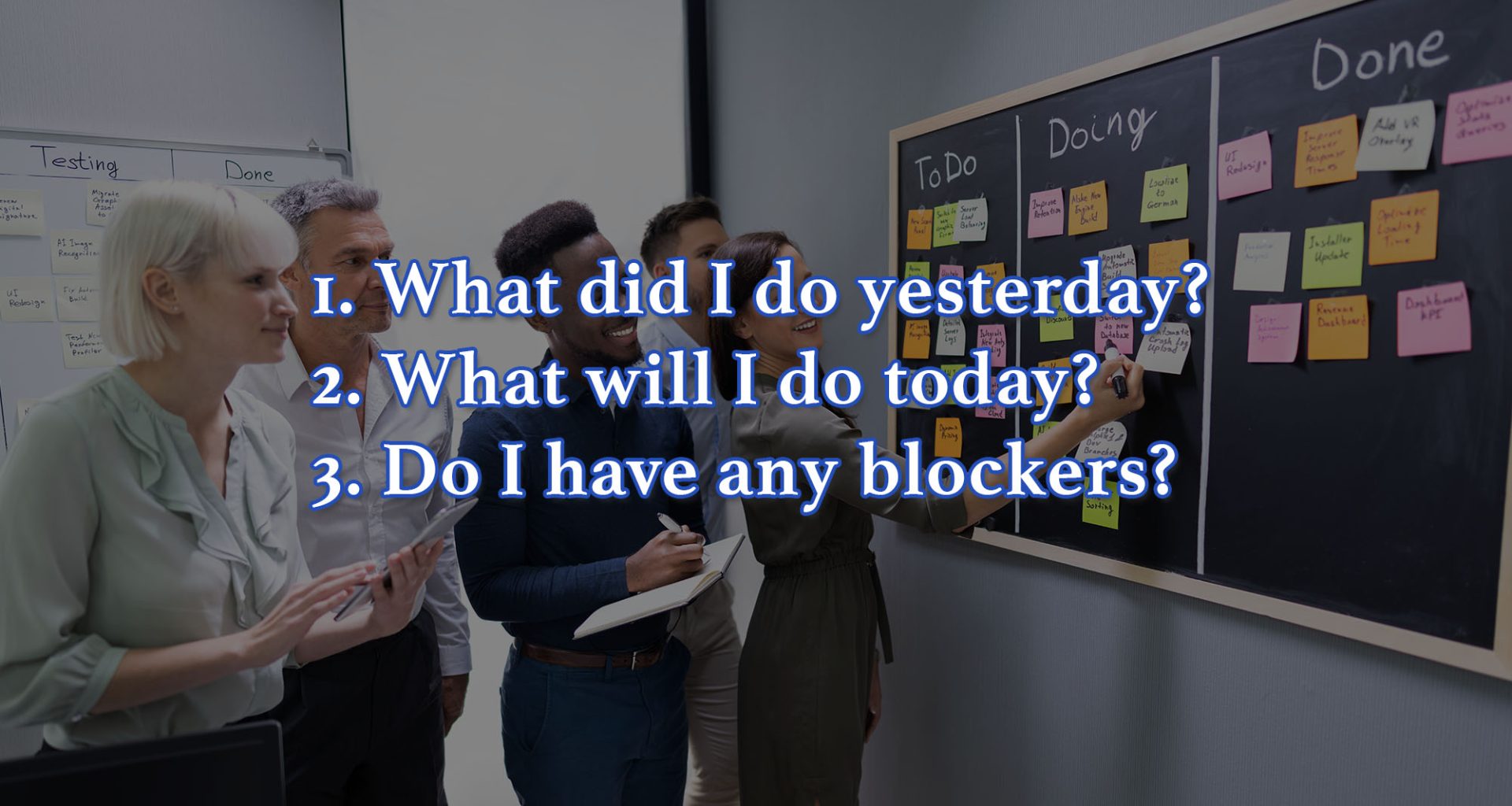
A Typical Standup
I’ve lost count of how many Daily Scrums, or standups, that I’ve attended where the Scrum Master, or even the Product Owner, calls on team members individually who provide answers to these 3 questions:
- What did I do yesterday?
- What am I doing today?
- Is anything blocking me?
And each and every person provides their answers. Unless there is a blocker there is really no cross-talk or discussion of value whatsoever. No one is paying much attention to what others are saying, they are just waiting their turn to answer the questions.
Congratulations! You’ve just created a daily status meeting.
Remember The Purpose
Something to keep in mind is that, during Sprint Planning, the team crafts a Sprint Goal. That is their defining purpose for the Sprint. The Sprint Goal is the single most important item of value to complete.
The purpose of the Daily Scrum is for the team to assess their progress towards completion of the Sprint Goal. The 3 questions are directed at the individual whereas we want to stress working as a team on a common goal.
Topics for the team to consider:
- Is this exact work still necessary? Do we need to adapt?
- If we are off track, how can we work together to deliver the desired value?
- What is our plan for today to make progress towards completing the Sprint Goal? Who needs to work together? Who is finishing something so they can now help someone else?
- Does anyone need help?
Some Alternatives
One of my favorite standup techniques is to ask these two questions:
- What is the most important thing we can finish today?
- Follow-up: How do we know?
This creates an emphasis on multiple things.
First, the focus is on finishing something. One of my favorite phrases is “stop starting, start finishing”. It’s a concept that Scrum Masters and Agile Coaches often stress. It’s a reminder to keep WIP (Work In Progress) low and to reduce multi-tasking and associated negative effects.
Secondly, it causes the team to assess the work from a value perspective – how do they know what is most important? And, of course, value creation is the entire purpose the team exists! If they struggle identifying what is highest value you’ve just discovered a coaching opportunity.
Another effective technique is to “walk the board” rather than calling on each team member individually.
In this method, the Scrum Master, or anyone on the team, starts by reading the title of the User Story that is in the rightmost state, at the top of the column. This should be the item that is nearest completion. The team discusses progress and how they will, as a team, deliver the value. This is the main purpose of this technique – to work as a team rather than individually.
The team progresses through the states from right to left, top to bottom of each state. This is working backwards from the items that are nearest completion to those that have just begun. This also reinforces “stop starting, start finishing”.d
For a more in-depth example of using this technique check out my article “The Walk the Board Standup“.
Mobbing
The last option I will recommend isn’t a standup technique. It’s an entirely new way of working for the team called Mobbing.
When mobbing the entire team works together on one story at a time. It’s a variation on pair programming and emphasizes learning as a team. For great information on how to mob in a remote environment, here is fantastic advice from Woody Zuill: https://www.remotemobprogramming.org/
If the team is mobbing they are working together all day. In such an environment, the standup becomes an unnecessary Scrum event. And in the spirit of Lean, if the event isn’t providing value it can be cancelled.
Wrapping Up
If your team continues to have status reports rather than a team conversation, finding ways to collaborate and work together more effectively to deliver the Sprint Goal, try one of the techniques listed above.
If your team uses another method please let me know in the comments below!
If you liked this post and want to learn more about Agile, Lean or Leadership, please consider purchasing a book from my Recommended Reading page.
Until next time!


